Thursday, August 31, 2023

Less Than One Month to Go Before Rock Samples from Bennu Return to Earth...

An artist's concept of OSIRIS-REx's sample return capsule laying in the Utah desert.
NASA's Goddard Space Flight Center / Conceptual Image Lab

NASA Completes Last OSIRIS-REx Test Before Asteroid Sample Delivery (Press Release - August 30)

A team led by NASA in Utah’s West Desert is in the final stages of preparing for the arrival of the first U.S. asteroid sample – slated to land on Earth in September.

A mockup of NASA’s OSIRIS-REx (Origins, Spectral Interpretation, Resource Identification and Security–Regolith Explorer) sample capsule was dropped Wednesday from an aircraft and landed at the drop zone at the Department of Defense’s Utah Test and Training Range in the desert outside Salt Lake City. This was part of the mission’s final major test prior to arrival of the actual capsule on September 24 with its sample of asteroid Bennu, collected in space almost three years ago.

“We are now mere weeks away from receiving a piece of solar system history on Earth, and this successful drop test ensures we’re ready,” said Nicola Fox, associate administrator of NASA’s Science Mission Directorate in Washington. “Pristine material from asteroid Bennu will help shed light on the formation of our solar system 4.5 billion years ago, and perhaps even on how life on Earth began.”

This drop test follows a series of earlier rehearsals – capsule recovery, spacecraft engineering operations and sample curation procedures – conducted earlier this spring and summer.

Now, with less than four weeks until the spacecraft’s arrival, the OSIRIS-REx team is nearing the end of rehearsals and ready for the actual delivery.

"I am immensely proud of the efforts our team has poured into this endeavor,” said Dante Lauretta, principal investigator for OSIRIS-REx at the University of Arizona, Tucson. “Just as our meticulous planning and rehearsal prepared us to collect a sample from Bennu, we have honed our skills for sample recovery.”

The capsule is carrying an estimated 8.8 ounces of rocky material collected from the surface of asteroid Bennu in 2020. Researchers will study the sample in the coming years to learn about how our planet and solar system formed, as well as the origin of organics that may have led to life on Earth.

The capsule will enter Earth’s atmosphere at 10:42 a.m. EDT (8:42 a.m. MDT), traveling about 27,650 mph. NASA’s live coverage of the capsule landing starts at 10 a.m. EDT (8 a.m. MDT), and will air on NASA Television, the NASA app and the agency’s website.

“We are now in the final leg of this seven-year journey, and it feels very much like the last few miles of a marathon, with a confluence of emotions like pride and joy coexisting with a determined focus to complete the race well,” said Rich Burns, project manager for OSIRIS-REx at NASA’s Goddard Space Flight Center in Greenbelt, Maryland.

Once located and packaged for travel, the capsule will be flown to a temporary clean room on the military range, where it will undergo initial processing and disassembly in preparation for its journey by aircraft to NASA’s Johnson Space Center in Houston, where the sample will be documented, cared for and distributed for analysis to scientists worldwide.

NASA’s Goddard Space Flight Center in Greenbelt, Maryland, provides overall mission management, systems engineering, and the safety and mission assurance for OSIRIS-REx. Dante Lauretta of the University of Arizona, Tucson, is the principal investigator.

The university leads the science team and the mission's science observation planning and data processing.

Lockheed Martin Space in Littleton, Colorado, built the spacecraft and provides flight operations. Goddard and KinetX Aerospace are responsible for navigating the OSIRIS-REx spacecraft.

Curation for OSIRIS-REx, including processing the sample when it arrives on Earth, will take place at NASA’s Johnson Space Center in Houston. International partnerships on this mission include the OSIRIS-REx Laser Altimeter instrument from CSA (the Canadian Space Agency) and asteroid sample science collaboration with JAXA’s (the Japan Aerospace Exploration Agency) Hayabusa2 mission.

OSIRIS-REx is the third mission in NASA's New Frontiers Program, managed by NASA's Marshall Space Flight Center in Huntsville, Alabama, for the agency's Science Mission Directorate in Washington.

Source: NASA.Gov

****
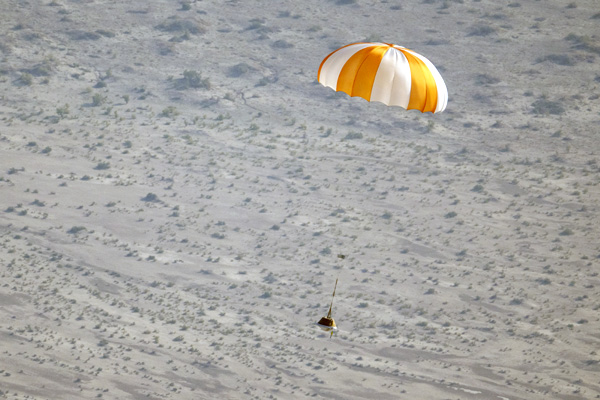
A full-scale training model of OSIRIS REx's sample return capsule is about to touch down at the Department of Defense's Utah Test and Training Range...on August 30, 2023.
NASA / Keegan Barber

Wednesday, August 30, 2023

Photos of the Day: It's Now One Week into the Chandrayaan-3 Mission...

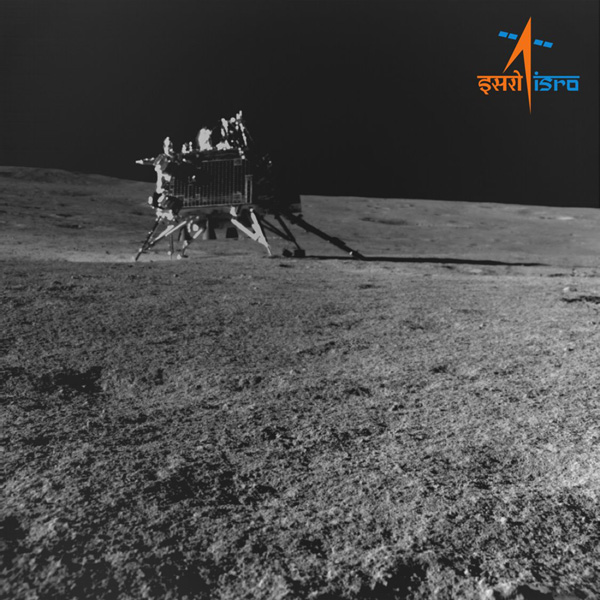
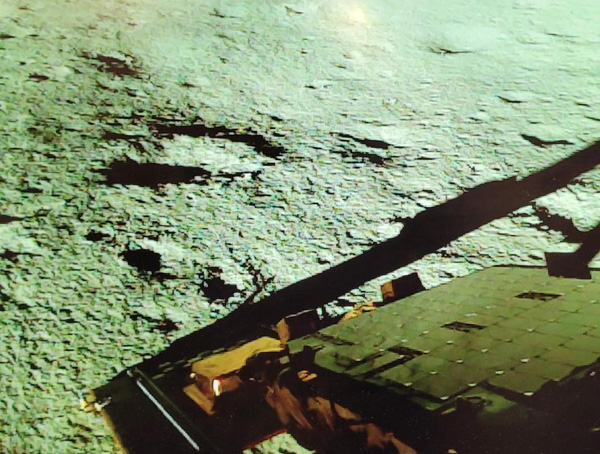
An image of the Vikram Lander that was taken by the Pragyan Rover from a distance of about 15 meters (49 feet) on the lunar surface...on August 30, 2023.

Just thought I'd share these cool images released by ISRO (the Indian Space Research Organisation) as its Chandrayaan-3 spacecraft have been on the Moon for seven days now!

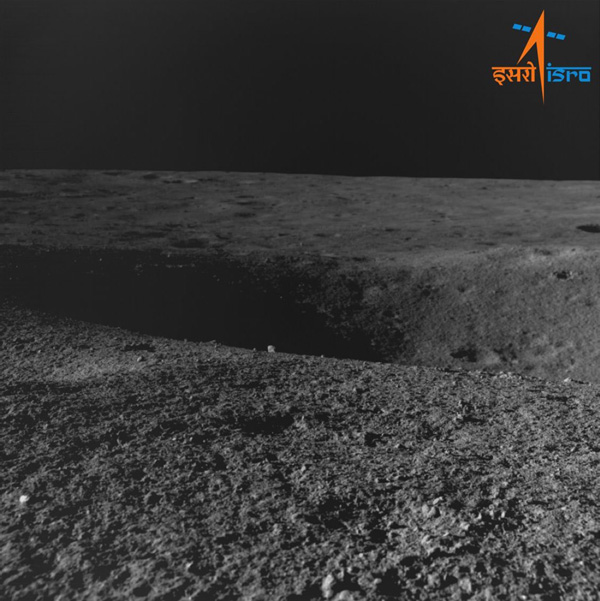
The photo above shows the Vikram Lander that was taken by the Pragyan Rover earlier today...while the pictures below show Pragyan as it rolled down the ramp of Vikram on August 23, and images of the lunar surface taken by the rover at the Moon's South Polar Region a few days ago.

Chandrayaan-3 is now halfway into its 14-day mission—as the end of the lunar day (which last 2 Earth weeks) will cause the spacecraft to lose solar power once lunar night (which is also 14 Earth days-long) arrives.

However, there is a chance that Chandrayaan-3 could possibly be revived once lunar day arrives once more. We'll see!

A screenshot of the Pragyan Rover rolling down the ramp of the Vikram Lander onto the lunar surface...on August 23, 2023.
ISRO

A screenshot of the Pragyan Rover after it rolled onto the lunar surface from the ramp of the Vikram Lander...on August 23, 2023.
ISRO

A screenshot of the Pragyan Rover moving about on the lunar surface after being deployed from the Vikram Lander.

An image of a lunar crater that was taken by the Pragyan Rover...on August 27, 2023.

An image taken by the Pragyan Rover of its own tracks on the lunar surface...on August 27, 2023.

Monday, August 28, 2023

Why I'm a Big Fan of THE BIG BANG THEORY...

The main cast of THE BIG BANG THEORY.

I can relate to the four main dudes on the hit CBS sitcom:

- Leonard: He's extremely infatuated with Penny and feels insecure whenever she talks to some random guy...

- Howard: Because he tries too hard with women (before he met Bernadette)...

- Raj: He's such a hopeless romantic that he tends to unwittingly come across as effeminate whenever he expresses feelings for a lady he cares about—and is unable to speak to certain (mostly gorgeous) women...

And

- Sheldon: He's extremely arrogant and narcissistic, and views sexual desire as an affliction that needs to be suppressed in the pursuit of new knowledge about the universe...before he met Amy.

And of course, all of them are huge comic book geeks and Star Wars fans. Happy Monday!

Sunday, August 27, 2023

Flying at Light Speed for 168 Months Now...

An artist's concept of the Gliese 581 star system.

Fourteen Light-Years... That’s how far the Hello From Earth message has traveled since being transmitted from a giant NASA antenna in Australia to the exoplanet Gliese 581d in the summer of 2009.

As of 7 PM California time tonight (12 PM Sydney time on Monday, August 28), the radio signal containing 25,878 goodwill text messages—including one by me—will have ventured across approximately 82 trillion miles (132 trillion kilometers) of deep space...which, as stated at the very start of this Blog entry, equals a distance of fourteen light-years.

The signal, despite traveling 186,000 miles per second (or 671 million miles per hour, or um, 1 billion kilometers per hour), will still take about 6 years to reach the Gliese 581 star system. Carry on!

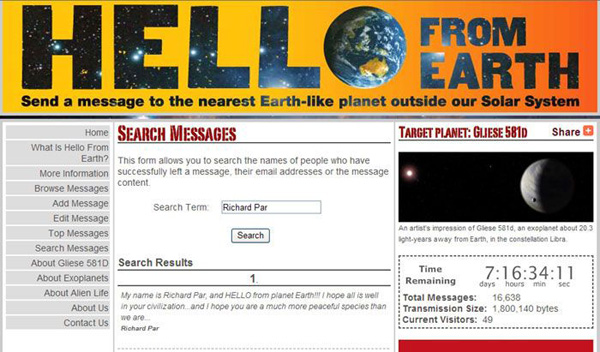
The message that I sent to interstellar space through the Hello From Earth project...on August 27, 2009.

Friday, August 25, 2023

Photo of the Day: The Criminal-in-Chief's Mug Shot...

Trump's mug shot.

It's sad that this guy—with 4 indictments and 91 criminal charges (and rising?) to his name—will most likely be the 2024 Republican presidential nominee...

The MAGA-infested GOP either needs to be disbanded or receive a major overhaul. But LOL at this X post Stormy Daniels made about Donald Trump reporting that he was 215 pounds in yesterday's booking documents at Fulton County, Georgia!

Thursday, August 24, 2023

The Mamba Will Be Immortalized Outside of The Crypt Early Next Year...

Kobe Bryant will be immortalized with his own statue outside of Crypto.com Arena in downtown Los Angeles...on February 8, 2024.
NBA.com

Lakers to Unveil Kobe Bryant Statue on 2.8.24 (Press Release)

On 2.8.24, fans can forever pay tribute to beloved Lakers Legend and five-time champion Kobe Bryant. The Los Angeles Lakers and Vanessa Bryant announced today that they will unveil Kobe Bryant's bronze statue at Star Plaza outside of Crypto.com Arena on February 8, 2024, prior to the Lakers' home game that evening.

"As you know, Kobe played his entire 20-year NBA career as a Los Angeles Laker," said Vanessa Bryant in a video to fans posted at 8:24 this morning. "Since arriving in this city and joining the Lakers organization, he felt at home here, playing in the City of Angels. On behalf of the Lakers, my daughters and me, I am so honored that, right in the center of Los Angeles, in front of the place known as the house that Kobe built, we are going to unveil his statue so that his legacy can be celebrated forever."

The February 8 ceremony will be outside the arena and details will be released in the coming months. Tickets to attend this special Lakers game on February 8, as well as the entire 2023-24 season, are available starting on August 25 at 12pm PT.

****

Wednesday, August 23, 2023

The Lunar South Polar Region Has Received Its First Robotic Visitor...

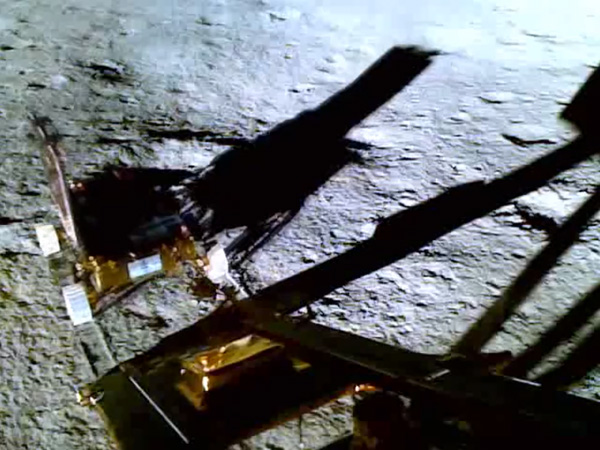
An image of a shadow cast upon the lunar surface by one of the Vikram Lander's four legs...after Chandrayaan-3 successfully touched down at the Moon's south polar region on August 23, 2023.

India’s Chandrayaan-3 Successfully Lands on the Moon (News Release)

The Indian Space Research Organisation (ISRO) has successfully landed its Chandrayaan-3 Lander Module on the surface of the Moon.

What happened?

Chandrayaan-3 launched from the Satish Dhawan Space Centre in Sriharikota Range (SDSC SHAR), India, on 14 July 2023 on a mission to demonstrate new technologies and to achieve India’s first soft landing on another celestial body.

The spacecraft arrived in lunar orbit on 5 August. On 17 August, the lander module separated from the propulsion module and soon after began its descent to the surface.

On 23 August, after a nail-biting wait, ISRO confirmed that Chandrayaan-3’s lander had successfully touched down in the Moon’s southern polar region as planned.

“Congratulations ISRO on this historic landing. ESA is proud to support the Chandrayaan-3 mission. Our ground stations are a core element of ESA’s support to its international partners, and I am pleased that with this activity, we are further strengthening ESA’s relationship with ISRO and with India. I look forward to supporting further pioneering ISRO missions, such as Aditya-L1, in the future,” says Rolf Densing, Director of Operations at ESA’s ESOC mission operations centre in Darmstadt, Germany.

How was ESA involved?

ESA is providing deep space communications support to the Chandrayaan-3 mission.

Communication is an essential part of every space mission. Ground stations on Earth keep operators connected to spacecraft as they venture into the unknown.

Without ground station support, it’s impossible to get any data from a spacecraft, to know how it’s doing, to know if it is safe or even to know where it is.

For the Chandrayaan-3 mission, ESA is coordinating routine support from its Kourou station in French Guiana and from Goonhilly Earth Station Ltd in the UK. These stations compliment support from NASA’s Deep Space Network and ISRO’s own stations.

ESA’s 35-metre antenna in New Norcia, Australia, provided additional tracking support during the lunar landing, serving as a back-up for ISRO’s own ground station.

New Norcia received the stream of vital signs from the Chandrayaan-3 lander – information about its health, location and trajectory – in parallel with the ISRO station. This type of back-up support is common during key moments of a space mission such as a landing.

It was this stream of telemetry that was ultimately used to confirm the success of this landing.

ESA’s deep space support to international partners

Many national space agencies operate deep space tracking stations that enable them to locate, track, command and receive telemetry and scientific data from their distant spacecraft.

But sometimes, particularly for deep space missions, operators need to track or command a spacecraft when it is outside the field of view of their own antennas, or to have a second ‘pair of eyes’ on their spacecraft during crucial moments.

Thanks to its global ‘Estrack’ network of ground stations, ESA can help its partners track, command and receive data from spacecraft almost anywhere in the Solar System via its ESOC mission operations centre in Darmstadt, Germany.

The Estrack network consists of ESA’s own ground stations, located across the globe, and ESA-coordinated support from third-party stations such as Goonhilly Earth Station Ltd.

What happens next?

The lander will soon deploy its rover. During its mission on the surface, which will last for one lunar day (14 days on Earth), the rover will carry out a number of scientific experiments.

ESA stations will continue to relay telemetry and scientific data gathered by the mission’s rover and lander module until the end of the surface operations.

Source: European Space Agency

****

An image of the Pragyan Rover being deployed by the Vikram Lander at the Moon's south polar region...on August 23, 2023.
ISRO

Wednesday, August 16, 2023

Hubble's Successor Takes a Detailed Look at the Most Distant Star Currently Known in the Universe...

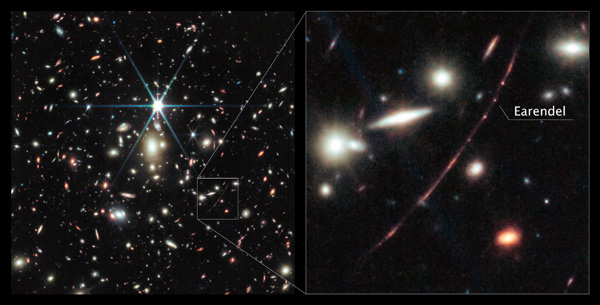
A cosmic image taken by NASA's James Webb Space Telescope...showing the location of Earendel, the most distant star ever detected.
Image: NASA, ESA, CSA, D. Coe (STScI/AURA for ESA; Johns Hopkins University), B. Welch (NASA’s Goddard Space Flight Center; University of Maryland, College Park). Image processing: Z. Levay.

Webb Reveals Colors of Earendel, Most Distant Star Ever Detected (News Release - August 8)

NASA’s James Webb Space Telescope has followed up on observations by the Hubble Space Telescope of the farthest star ever detected in the very distant universe, within the first billion years after the Big Bang. Webb’s NIRCam (Near-Infrared Camera) instrument reveals the star to be a massive B-type star more than twice as hot as our Sun, and about a million times more luminous.

The star, which the research team has dubbed Earendel, is located in the Sunrise Arc galaxy and is detectable only due to the combined power of human technology and nature via an effect called gravitational lensing. Both Hubble and Webb were able to detect Earendel due to its lucky alignment behind a wrinkle in space-time created by the massive galaxy cluster WHL0137-08.

The galaxy cluster, located between us and Earendel, is so massive that it warps the fabric of space itself, which produces a magnifying effect, allowing astronomers to look through the cluster like a magnifying glass.

While other features in the galaxy appear multiple times due to the gravitational lensing, Earendel only appears as a single point of light even in Webb’s high-resolution infrared imaging. Based on this, astronomers determine that the object is magnified by a factor of at least 4,000, and thus is extremely small – the most distant star ever detected, observed 1 billion years after the Big Bang.

The previous record-holder for the most distant star was detected by Hubble and observed around 4 billion years after the Big Bang. Another research team using Webb recently identified a gravitationally-lensed star that they nicknamed Quyllur, a red giant star observed 3 billion years after the Big Bang.

Stars as massive as Earendel often have companions. Astronomers did not expect Webb to reveal any companions of Earendel since they would be so close together and indistinguishable in the sky.

However, based solely on the colors of Earendel, astronomers think they see hints of a cooler, redder companion star. This light has been stretched by the expansion of the universe to wavelengths longer than Hubble’s instruments can detect, and so was only detectable with Webb.

Webb’s NIRCam also shows other notable details in the Sunrise Arc, which is the most highly-magnified galaxy yet detected in the universe’s first billion years. Features include both young star-forming regions and older established star clusters as small as 10 light-years across.

On either side of the wrinkle of maximum magnification, which runs right through Earendel, these features are mirrored by the distortion of the gravitational lens. The region-forming stars appear elongated, and is estimated to be less than 5 million years old.

Smaller dots on either side of Earendel are two images of one older, more established star cluster, estimated to be at least 10 million years old. Astronomers determined that this star cluster is gravitationally-bound and likely to persist until the present day.

This shows us how the globular clusters in our own Milky Way might have looked when they formed 13 billion years ago.

Astronomers are currently analyzing data from Webb’s NIRSpec (Near-Infrared Spectrograph) instrument observations of the Sunrise Arc galaxy and Earendel, which will provide precise composition and distance measurements for the galaxy.

Since Hubble’s discovery of Earendel, Webb has detected other very distant stars using this technique, though none quite as far as Earendel. The discoveries have opened a new realm of the universe to stellar physics, and new subject matter to scientists studying the early universe, where galaxies were once the smallest detectable cosmic objects.

The research team has cautious hope that this could be a step towards the eventual detection of one of the very first generation of stars, composed only of the raw ingredients of the universe created in the Big Bang – hydrogen and helium.

Source: NASA.Gov

Tuesday, August 15, 2023

America's Next Jupiter-bound Orbiter Has Received Its Communications Dish...

Inside the Spacecraft Assembly Facility at NASA's Jet Propulsion Laboratory in California, the Europa Clipper's high-gain antenna is attached to the orbiter...on August 14, 2023.
NASA / JPL - Caltech

NASA’s Europa Probe Gets a Hotline to Earth (News Release)

The addition of a high-gain antenna will enable the agency’s Europa Clipper spacecraft – set to launch in October 2024 – to communicate with mission controllers hundreds of millions of miles away.

NASA’s Europa Clipper is designed to seek out conditions suitable for life on an ice-covered moon of Jupiter. On August 14, the spacecraft received a piece of hardware central to that quest: the massive dish-shaped high-gain antenna.

Stretching 10 feet (3 meters) across the spacecraft’s body, the high-gain antenna is the largest and most prominent of a suite of antennas on Europa Clipper. The spacecraft will need it as it investigates the ice-cloaked moon that it’s named after, Europa, some 444 million miles (715 million kilometers) from Earth.

A major mission goal is to learn more about the moon’s subsurface ocean, which might harbor a habitable environment.

Once the spacecraft reaches Jupiter, the antenna’s radio beam will be narrowly directed toward Earth. Creating that narrow, concentrated beam is what high-gain antennas are all about.

The name refers to the antenna’s ability to focus power, allowing the spacecraft to transmit high-powered signals back to NASA’s Deep Space Network on Earth. That will mean a torrent of science data at a high rate of transmission.

The precision-engineered dish was attached to the spacecraft in carefully choreographed stages over the course of several hours inside a Spacecraft Assembly Facility bay at NASA’s Jet Propulsion Laboratory in Southern California. “The antenna has successfully completed all of its stand-alone testing,” said Matthew Bray a few days before the antenna was installed. “As the spacecraft completes its final testing, radio signals will be looped back through the antenna via a special cap, verifying that the telecom signal paths are functional.”

Based at the Johns Hopkins University Applied Physics Laboratory in Laurel, Maryland, Bray is the designer and lead engineer for the high-gain antenna, which he began working on in 2014. It’s been quite a journey for Bray, and for the antenna.

Just over the past year, he’s seen the antenna crisscross the country in the lead-up to the installation. Its ability to beam data precisely was tested twice in 2022 at NASA’s Langley Research Center in Hampton, Virginia.

Between those two visits, the antenna made a stop at NASA’s Goddard Space Flight Center in Greenbelt, Maryland, for vibration and thermal vacuum testing to see if it could handle the shaking of launch and the extreme temperatures of outer space.

Then it was on to JPL in October 2022 for installation on the spacecraft in preparation for shipment next year to NASA’s Kennedy Space Center in Florida.

The long journey to Jupiter begins with launch from Kennedy in October 2024.

Europa in Their Sights

“The high-gain antenna is a critical piece in the buildup of Europa Clipper,” said Jordan Evans, the Clipper project manager at JPL. “It represents a very visible piece of hardware that provides the capability that the spacecraft needs to send the science data back from Europa. Not only does it look like a spacecraft now that it has the big antenna, but it’s ready for its upcoming critical tests as we progress towards launch.”

The spacecraft will train nine science instruments on Europa, all producing large amounts of rich data: high-resolution color and stereo images to study its geology and surface; thermal images in infrared light to find warmer areas where water could be near the surface; reflected infrared light to map ices, salts and organics; and ultraviolet light readings to help determine the makeup of atmospheric gases and surface materials.

Clipper will bounce ice-penetrating radar beams off the subsurface ocean to determine its depth, as well as the thickness of the ice crust above it. A magnetometer will measure the moon’s magnetic field to confirm the deep ocean’s existence and thickness of the ice.

The high-gain antenna will stream most of that data back to Earth over the course of 33 to 52 minutes. The strength of the signal and amount of data it can send at one time will be far greater than that of NASA’s Galileo probe, which ended its eight-year Jupiter mission in 2003.

On site at JPL for the antenna installation was Simmie Berman, the radio frequency module manager at APL. Like Bray, she began her work on the antenna in 2014.

The radio frequency module includes the spacecraft’s entire telecommunications subsystem and a total of seven antennas, the high-gain among them. Berman's job during installation was to ensure the antenna was properly mounted to the spacecraft and that the components are correctly oriented and well integrated.

While the engineers at both APL and JPL have practiced the installation many times, virtually and with real-world mock-ups, August 14 was the first time the high-gain antenna was attached to the spacecraft.

“I’ve never worked on anything of this magnitude, in terms of physical size and also in terms of just general interest,” she said. “Little kids know where Jupiter is. They know what Europa looks like. It’s supercool to get to work on something that has the potential for such a big impact, in terms of knowledge, for humanity.”

After completing this major milestone, Europa Clipper still has a few more steps and a few more tests ahead as it’s prepared for its trip to the outer solar system.

Source: NASA.Gov

****

A snapshot I took of Europa Clipper's high-gain antenna inside the Spacecraft Assembly Facility at NASA's Jet Propulsion Laboratory in California...on July 20, 2023.
Richard T. Par


Monday, August 14, 2023

Nova-C Is Scheduled to Head to the Moon Before the Thanksgiving Holiday!

Intuitive Machines' Nova-C lander is scheduled to launch from NASA's Kennedy Space Center in Florida this November.
Intuitive Machines

Intuitive Machines' Nova-C spacecraft is targeted for launch to the Moon during a 6-day window...from November 15 to 20! The robotic lander is set to touch down at the lunar South Pole Region—in support of NASA's Artemis program.

Nova-C should be ready for shipment to Cape Canaveral in Florida by September 15. It will be attached to the DOGE-1 cubesat and mated to a SpaceX Falcon 9 rocket for flight from Kennedy Space Center's Launch Complex 39A.

Click here for more details!

An artist's concept of Intuitive Machines' Nova-C lander on the lunar surface.
Intuitive Machines