Sunday, May 30, 2021

You Friggin' SUCK, Crypto.com App...

Crypto.com basically stole my money when it updated its app (without warning users) and made it incompatible with my smartphone...thus preventing me from gaining access to my investment.

Three days ago, I found out that the mobile app I was using to buy cryptocurrency, Crypto.com, updated its program without letting users know in advance...causing me to lose around $325 (the amount that I had last time I checked my balance on Thursday, May 27) in investment. So how did I lose that $325, you ask? Well, the app is no longer compatible with my smartphone (and Crypto.com doesn't provide the ability to buy and sell coins on a PC instead), which means that I would need to buy a whole new device—even though my current Android is working fine—to regain access to my crypto. And the thought of having to spend a few hundred dollars (or over a thousand dollars if I were to finally purchase an iPhone) on a new device just to keep track of a financial investment that is currently worth less than the phone I'm viewing it on annoys the hell out of me.

So what's the cryptocurrency that I invested in, you're wondering? You guessed it— The Shiba Inu coin! I originally owned Dogecoins, but I sold all of them since 1.) I wanted to focus on buying more SHIB instead (I'm currently at 36 million coins), and 2.) the time to buy DOGE was last year. For the amount of money that you need to spend in order to acquire enough Dogecoins to make a significant profit (which would be over a thousand dollars), you can buy a hundred million to a billion Shiba coins for that same amount and patiently wait for them to go up in value over the coming years. Dogecoin, after all, took 8 years since its 2013 inception to reach where it is today...and it's not even at a dollar per coin yet.

So going back to the original point of this Blog entry, Crypto.com sucks. While my Android has been up for a replacement since last year, as mentioned in the first paragraph above it's still working well...and I find it infuriating that one app is forcing me to change my phone to regain access to my commodity. Would it be overdoing it if I said that the folks behind Crypto.com are crooks? They basically stole my money—and based on what its customer service told me through Twitter (shown below)—the only way to get it back is to unnecessarily spend cash on an unneeded device.

Combined this with the fact that the Los Angeles Lakers should've won Game 4 against the Phoenix Suns (even without Anthony Davis on the court) today, and you can see that this Sunday is garbage. For me, at least. If I do get a new phone, I'm still gonna talk trash about Crypto.com...even if I end up selling all Shiba coins and withdrawing my money from Crypto's wallet. We'll see.

The pathetic answer that Crypto.com's customer service provided through Twitter on how to regain access to its app without unnecessarily spending money to do so.

Invest in the Shiba Inu coin! But try NOT to do it on Crypto.com...

Thursday, May 27, 2021

Celebrating Laker Victories Today and on This Day 20 Years Ago...

With Anthony Davis providing a screen, LeBron James drives in toward the basket during Game 3 between the Los Angeles Lakers and the Phoenix Suns at STAPLES Center...on May 27, 2021.
Adam Pantozzi / NBA E

Less than two hours ago, the Lakers went up, 2-1, in their first-round series against the Phoenix Suns when Los Angeles emerged victorious, 109-95, in Game 3 at STAPLES Center. This was the first time Anthony Davis and LeBron James played an NBA postseason game at STAPLES Center, and also the first time since 2012 that the Lakers won a playoff match in their home arena. Kobe would've been proud.

Speaking of Kobe, today also marks 20 years since he, Shaquille O'Neal, Derek Fisher and the rest of the Lakers swept the San Antonio Spurs, 111-82, in Game 4 of the Western Conference Finals. The Lakers were undefeated in the postseason, 11-0, up until their Game 1 loss in the 2001 NBA Finals. At the end, however, the Lake Show prevailed over Allen Iverson and the Philadelphia 76ers in 5 games to win the NBA championship...and made history by having the best postseason record in league history at 15-1. The Chicago Bulls had a 15-2 record at the conclusion of the 1996 NBA Playoffs.

Here's hoping that Anthony Davis, LeBron and Co. continue to play well and eventually move onto the next playoff series (obviously). I don't wanna jinx it, but with the Clippers currently down 0-2 in their matchup against the Dallas Mavericks, and the Memphis Grizzlies having taken homecourt advantage away from the No. 1 Utah Jazz, the Lakers might have a considerable chance of reaching the NBA Finals two decades after Shaq and Kobe won their back-to-back title. Happy Thursday.

PS: The photo below is actually inaccurate. It's from Game 1 of the 2001 Western Conference Finals. Game 4 took place at STAPLES Center. I'm only using this image because you know, Mamba Forever.

Kobe Bryant dunks in Game 1 of the 2001 NBA Western Conference Finals...on May 19, 2001.
JAMES NIELSEN / AFP via Getty Images

Tuesday, May 25, 2021

Europa Clipper Update: New Discoveries on Europa Await NASA's Flagship Mission to Jupiter's Ocean Moon...

An artist's concept of NASA's Europa Clipper spacecraft flying above Jupiter's icy moon Europa.
NASA / JPL - Caltech

Europa’s Interior May Be Hot Enough to Fuel Seafloor Volcanoes (News Release)

Jupiter’s moon Europa has an icy crust covering a vast, global ocean. The rocky layer underneath may be hot enough to melt, leading to undersea volcanoes.

New research and computer modeling show that volcanic activity may have occurred on the seafloor of Jupiter’s moon Europa in the recent past – and may still be happening. NASA’s upcoming Europa Clipper mission, targeting a 2024 launch, will swoop close to the icy moon and collect measurements that may shed light on the recent findings.

Scientists have strong evidence that Europa harbors an enormous ocean between its icy crust and rocky interior. The new work shows how the moon may have enough internal heat to partially melt this rocky layer, a process that could feed volcanoes on the ocean floor. The recent 3D modeling of how this internal heat is produced and transferred is the most detailed and thorough examination yet of the effect this interior heating has on the moon.

The key to Europa’s rocky mantle being hot enough to melt lies with the massive gravitational pull Jupiter has on its moons. As Europa revolves around the gas giant, the icy moon’s interior flexes. The flexing forces energy into the moon’s interior, which then seeps out as heat (think of how repeatedly bending a paperclip generates heat). The more the moon’s interior flexes, the more heat is generated.

The research, published recently in Geophysical Research Letters, models in detail how Europa’s rocky part may flex and heat under the pull of Jupiter’s gravity. It shows where heat dissipates and how it melts that rocky mantle, increasing the likelihood of volcanoes on the seafloor.

Volcanic activity on Europa has been a topic of speculation for decades. By comparison, Jupiter’s moon Io is obviously volcanic. Hundreds of volcanoes there erupt lava fountains and eject volcanic gas and dust up to 250 miles (400 kilometers) high – activity that is due to the same kind of internal heating caused by Jupiter’s pull. But Europa is farther away than Io is from its host planet, so scientists have wondered whether the effect would be similar under the icy surface.

Led by Marie Běhounková of Charles University in the Czech Republic, the authors further predicted that volcanic activity is most likely to occur near Europa’s poles – the latitudes where the most heat is generated. They also looked at how volcanic activity may have evolved over time. Long-lived energy sources give more opportunity for potential life to have developed.

Underwater volcanoes, if present, could power hydrothermal systems like those that fuel life at the bottom of Earth’s oceans. On Earth, when seawater comes into contact with hot magma, the interaction results in chemical energy. And it is chemical energy from these hydrothermal systems, rather than from sunlight, that helps support life deep in our own oceans. Volcanic activity on Europa’s seafloor would be one way to support a potential habitable environment in that moon’s ocean.

“Our findings provide additional evidence that Europa’s subsurface ocean may be an environment suitable for the emergence of life,” Běhounková said. “Europa is one of the rare planetary bodies that might have maintained volcanic activity over billions of years, and possibly the only one beyond Earth that has large water reservoirs and a long-lived source of energy.”

Direct Observations

NASA scientists will have the opportunity to put the new predictions to the test when Europa Clipper reaches its target in 2030. The spacecraft will orbit Jupiter and perform dozens of close flybys of Europa to map the moon and investigate its composition. Among the science data it collects, the spacecraft will survey the surface in detail and sample the moon’s thin atmosphere.

The surface and atmosphere observations will give scientists a chance to learn more about the moon’s interior ocean if the water percolates up through the icy crust. Scientists believe the exchange of material between the ocean and the crust would leave traces of seawater on the surface. They also believe the exchange may emit gas, and possibly even plumes of water vapor, with ejected particles that could contain materials coming from the seafloor.

As Europa Clipper measures the moon’s gravity and magnetic field, anomalies in those areas, especially toward the poles, could help confirm the volcanic activity predicted by the new research.

“The prospect for a hot, rocky interior and volcanoes on Europa’s seafloor increases the chance that Europa’s ocean could be a habitable environment,” said Europa Clipper Project Scientist Robert Pappalardo of NASA’s Jet Propulsion Laboratory in Southern California. “We may be able to test this with Europa Clipper’s planned gravity and compositional measurements, which is an exciting prospect.”

Source: Jet Propulsion Laboratory

****

An illustration depicting Europa's watery interior.
NASA / JPL - Caltech / Michael Carroll

Monday, May 24, 2021

If the INTERSTELLAR PROBE Launched on a 'Big Orange Rocket' for Its Journey to the Edge of Our Solar System, and Beyond...

An artist's concept of the proposed Interstellar Probe.

Today, I read a great article on NASASpaceflight.com about how NASA and Boeing are trying to optimize the space at the Michoud Assembly Facility (MAF) in Louisiana to begin building more than two Space Launch System (SLS) core stage boosters per year. As of right now, a pair of SLS boosters are being manufactured at MAF...the core stages for Artemis 2 (which is set to launch in 2023) and Artemis 3 (which would send astronauts to the Moon for a lunar landing mission as early as 2024). NASA's goal is to maximize the space inside MAF's buildings to make room for at least three core stage boosters—which would obviously increase the construction and launch cadence for SLS rockets embarking on Artemis missions.

So what does this have to do with the Interstellar Probe, you ask? Well, NASA obtaining the ability to fabricate more than one SLS booster at a time (like it was able to do with the space shuttle's external fuel tank before this program ended a decade ago) would allow the agency to not only have core stages available for Artemis flights, but for uncrewed, non-Artemis missions as well. The lack of this ability has led to the U.S. Congress ending the mandate that the SLS launch a very important interplanetary mission—the Europa Clipper—as originally envisioned. With the Interstellar Probe, the mission planners are literally banking on the so-called Big Orange Rocket to send their spacecraft to the outer edge of our solar system next decade.

The SLS presumably has the capability to give the Interstellar Probe the necessary speed to travel at least 8 to 9 Astronomical Units (a single Astronomical Unit, or AU, equates to 93 million miles—or the distance from the Earth to the Sun) a year...which would allow the spacecraft to reach the edge of the Sun's heliosphere at 120+ AU within 15 years. SpaceX fans reading this will probably point out that the Starship/Super Heavy vehicle can probably hurl the Interstellar Probe to much greater velocities than the SLS. However, according to this article, the mission planners don't want the spacecraft to travel too fast nor too slow—as the Interstellar Probe needs to be able to accurately gather data on the solar wind during its eventual voyage into the cosmos. So assuming that its Artemis 1 test flight goes well at the end of this year (or most likely in early 2022), the SLS has a very important payload on its long-term manifest if 1.) construction space is adequately maximized within the buildings at the Michoud Assembly Facility to manufacture SLS boosters at a rapid pace, and 2.) the Interstellar Probe is greenlit by NASA within the next few years! Happy Monday.

Sunday, May 23, 2021

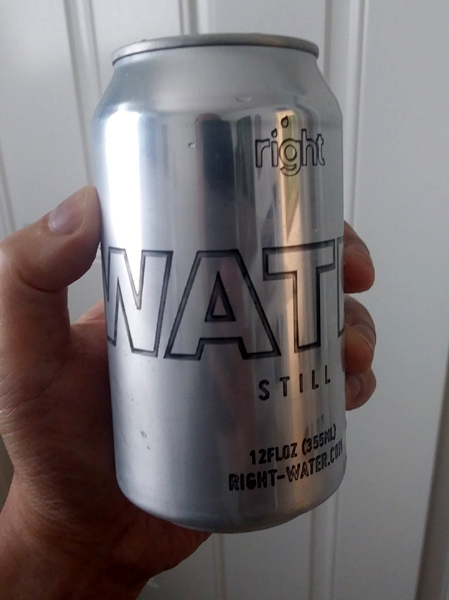
Photo of the Day: Water in a Can!

Just thought I'd share this picture I took of a can of water that I received at work over two months ago. Due to COVID-19 protocols and the need to maintain a clean environment, the TV production that I worked on handed out this unique beverage at the craft service table instead of the usual water bottles. Water cans may not, in fact, be unique—but this is the first time that I myself drank from one! Gotta love set life...for the most part.

And no, this photo isn't recent. I drank this water a few days after I worked on that production, heh. Happy Sunday!

A can of water that I received at work over two months ago.

Friday, May 21, 2021

VIPER Remains on Track to Head to the Lunar South Pole in 2023...

An artist's concept of NASA's VIPER rover on the surface of the Moon.
NASA Ames / Daniel Rutter

NASA Rover to Search for Water, Other Resources on Moon (News Release - May 20)

As part of the Artemis program, NASA is planning to send its first mobile robot to the Moon in late 2023 in search of ice and other resources on and below the lunar surface. Data from the Volatiles Investigating Polar Exploration Rover, or VIPER, would help the agency map resources at the lunar South Pole that could one day be harvested for long-term human exploration at the Moon.

VIPER’s design calls for using the first headlights on a lunar rover to aid in exploring the permanently shadowed regions of the Moon. These areas haven’t seen sunlight in billions of years and are some of the coldest spots in the solar system. Running on solar power, VIPER will need to quickly maneuver around the extreme swings in light and dark at the lunar South Pole.

“The data received from VIPER has the potential to aid our scientists in determining precise locations and concentrations of ice on the Moon and will help us evaluate the environment and potential resources at the lunar south pole in preparation for Artemis astronauts,” said Lori Glaze, director for NASA’s Planetary Science Division at the agency’s Headquarters in Washington. “This is yet another example of how robotic science missions and human exploration go hand in hand, and why both are necessary as we prepare to establish a sustainable presence on the Moon.”

NASA awarded a task order to Astrobotic for VIPER’s launch, transit and delivery to the lunar surface as part of the agency’s Commercial Lunar Payload Services (CLPS) initiative.

Once on the Moon, the rover will explore lunar craters using a specialized set of wheels and suspension system to cover a variety of inclines and soil types. The rover’s design significantly enhances upon a former robotic concept to prospect the Moon called Resource Prospector, which NASA canceled in early 2018. Since then, the VIPER mission duration was extended from one to three lunar days (100 Earth days). VIPER has evolved to increase its science capabilities, enabling more data collection at the lunar surface.

VIPER will carry four instruments, including the Regolith and Ice Drill for Exploring New Terrains (TRIDENT) hammer drill, the Mass Spectrometer Observing Lunar Operations (MSolo) instrument, the Near Infrared Volatiles Spectrometer System (NIRVSS) and the Neutron Spectrometer System (NSS). Earlier versions of these instruments will be tested on the lunar surface ahead of the VIPER mission, allowing the team to reduce risk and test instrument performance data.

Slated to arrive via Astrobotic's first flight, MSolo, NVSS and NIRVSS are among the payloads that will land on the lunar surface on one of the first CLPS deliveries to the Moon. Versions of TRIDENT and MSolo will ride to the Moon in late 2022 aboard the Polar Resources Ice Mining Experiment (PRIME-1) technology demonstration, delivered by Intuitive Machines on its second CLPS flight.

The VIPER design has come a long way. Following completion of its formulation phase, the agency recently approved the rover to enter the mission development phase. VIPER progress continues moving full speed ahead. NASA’s investment in the mid-size rover for mission development costs and operations is $433.5 million. The current delivery contract value for Astrobotic to deliver VIPER to the Moon through CLPS is approximately $226.5 million.

“VIPER will be the most capable robot NASA has ever sent to the lunar surface and allow us to explore parts of the Moon we’ve never seen” said Sarah Noble, program scientist for VIPER at NASA Headquarters. “The rover will teach us about the origin and distribution of water on the Moon and prepare us to harvest resources 240,000 miles from Earth that could be used to safely send astronauts even farther into space, including Mars.”

Throughout the Artemis program, NASA will send robots and humans to explore more of the Moon than ever before. When astronauts return to the lunar surface for the first time since 1972, they will follow in VIPER’s wheel prints and land at the lunar South Pole. That mission will include landing the first woman on the Moon. She will be one of two crew members paving the way for sustainable lunar exploration missions with crew.

Source: NASA.Gov

Thursday, May 20, 2021

A Falcon 9 Rocket Will Send the Blue Ghost to the Moon Two Years from Now...

An artist's concept of Firefly Aerospace's Blue Ghost lunar lander on the surface of the Moon.
Firefly Aerospace

Firefly Aerospace Awards Contract to SpaceX to Launch Blue Ghost Mission to Moon in 2023 (Press Release)

CEDAR PARK, Texas--(BUSINESS WIRE)-- Firefly Aerospace Inc., a leading provider of economical and dependable launch vehicles, spacecraft, and in-space services, announced today that it has awarded a contract to SpaceX to launch its Blue Ghost lunar lander in 2023. Blue Ghost will be carrying 10 payloads for NASA’s Commercial Lunar Payload Services (CLPS) task order 19D mission, in addition to separately-contracted commercial payloads.

Shea Ferring, Firefly Senior Vice President of Spacecraft, said, “Firefly is excited to fly our Blue Ghost spacecraft on the highly-reliable Falcon 9, which will deliver NASA instruments and technology demonstration payloads that support NASA science goals and NASA’s Artemis program. The high performance of SpaceX’s Falcon 9 launch vehicle permits a lunar transit using minimal Blue Ghost propulsion resources, thereby allowing the lander to deliver more than 150 kg of payload to the lunar surface.”

Firefly was awarded the CLPS 19D task order by NASA in February 2021 and has since made rapid progress on the Blue Ghost program. The team has key long lead items on order, production underway, and is conducting regular vision navigation test flights at Firefly’s one-acre Briggs, Texas lunar landscape site.

“The Blue Ghost mission will include delivery of NASA payloads that will support scientific lunar research and will contribute to developing a sustainable presence on the Moon as part of the Artemis program,” said SpaceX Vice President of Commercial Sales Tom Ochinero. “We’re honored Firefly selected Falcon 9 for launch.”

Tom Markusic, Firefly CEO, said “Firefly is excited to leverage the performance and reliability of Falcon 9 to propel Blue Ghost on the first phase of its journey to the Moon.”

Blue Ghost (named after the rare Phausis reticulata firefly) will land at Mare Crisium in the Moon’s Crisium basin and operate on-board payloads through lunar transit, during lunar orbit, and on the lunar surface for a complete lunar day (about 14 Earth days) and well into the freezing dark of lunar night.

Opportunities are open for early-career and seasoned professionals alike to work on Firefly’s lunar lander, launch vehicles, and various space-related projects.

Source: Firefly Aerospace

****

A SpaceX Falcon 9 rocket lifts off from Launch Complex 39A at NASA's Kennedy Space Center in Florida.
SpaceX

Wednesday, May 19, 2021

Photo of the Day: The Lakers Earn Their (7th) Spot in the NBA Playoffs...

LeBron James shoots a clutch 3-pointer over Steph Curry that allowed the Los Angeles Lakers to defeat the Golden State Warriors, 103-100, at STAPLES Center...on May 19, 2021.
NBA

Just thought I'd share this photo of LeBron James shooting a clutch 3-pointer over Steph Curry that allowed the Los Angeles Lakers to defeat the Golden State Warriors, 103-100, during their Play-In Tournament game at STAPLES Center tonight. With their 7th spot in the NBA's Western Conference now clinched, the Lakers will take on the No. 2 Phoenix Suns in Arizona this Sunday, May 23. Game 1 of this first-round series will air on ABC at 12:30 PM, Pacific Time (3:30 PM, Eastern Time).

The Lakers have been a great road team during much of the 2020-'21 regular season... Here's hoping that this continues through the NBA Playoffs as well!

Sunday, May 16, 2021

The Lakers Take on the Warriors in a Playoff Before the NBA Playoffs...

LeBron James tries to block a shot by Steph Curry in a game between the Los Angeles Lakers and the Golden State Warriors.
Noah Graham / NBAE via Getty Images

Lakers Qualify for NBA Play-In Tournament (News Release)

The Play-In Tournament begins Tuesday, May 18 and concludes Friday, May 21. In the Western Conference, the Lakers will take on the Warriors on 5/19 at 7pm PT. If they win, the Lakers will be the 7th seed and take on the Phoenix Suns. If the Lakers lose, they would take on the winner of Memphis and San Antonio on 5/21 (time TBD) with the winner of that game being the 8th seed and would face Utah in the first round of the playoffs. Both possible play-in games for the Lakers will be broadcast exclusively on ESPN.

Here is a description of the Play-In tournament format:

The teams with the seventh-highest and eighth-highest winning percentages in each conference will each have two opportunities to win one game to earn a playoff spot. The teams with the ninth-highest and tenth-highest winning percentages in each conference will each have to win two consecutive games to earn a playoff spot.

At the conclusion of the regular season but before the first round of the playoffs, the team with the 7th-highest winning percentage in each conference will host the team with the 8th-highest winning percentage in a Play-In Game (the “Seven-Eight Game”). The winner of the Seven-Eight Game in each conference will earn the No. 7 seed.

The team with the 9th-highest winning percentage in each conference will host the team with the 10th-highest winning percentage in the “Nine-Ten Game”. The loser of the Seven-Eight Game will host the winner of the Nine-Ten Game in a Play-In Game, and the winner of that game in each conference will earn the No. 8 seed.

The winners of the Play-In tournament will receive the 7th and 8th-seeded positions in each conference. Following the Play-In Tournament, the NBA Playoffs will commence with the traditional 16-team, best-of-seven series structure. The NBA Playoffs will start on Saturday, May 22.

Source: NBA.com

Saturday, May 15, 2021

Kobe Continues to be Immortalized...

Just thought I'd share this image after Kobe Bryant was officially inducted into the Naismith Memorial Basketball Hall of Fame during a ceremony at Uncasville, Connecticut earlier today. To quote Vanessa Bryant, who gave an acceptance speech in her late husband's honor: "He's still winning."

Congrats, Mamba.

Kobe Bryant was posthumously inducted into the Naismith Memorial Basketball Hall of Fame on May 15, 2021.