Thursday, January 31, 2019

Trojan-bound in 2021: Lucy Gets a Launch Vehicle for Its Trip to Primitive Asteroids Near Jupiter...

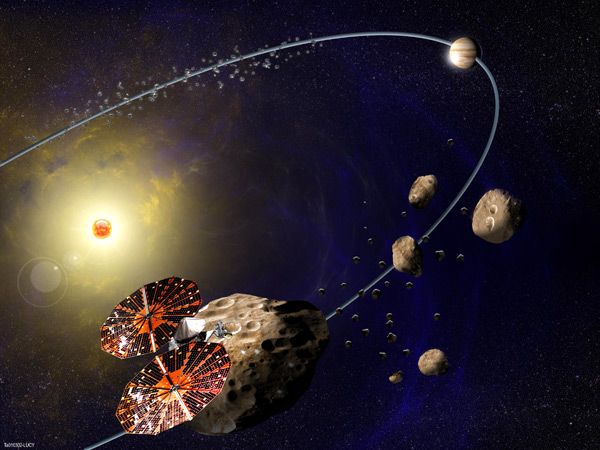
An artist's concept of the Lucy spacecraft exploring Trojan asteroids in Jupiter's orbit.
Southwest Research Institute

NASA Awards Launch Services Contract for Lucy Mission (Press Release)

NASA has selected United Launch Services LLC (ULS) of Centennial, Colorado, to provide launch services for the agency’s first-ever mission to explore Trojan asteroids.

The Lucy mission currently is targeted to launch in October 2021 on an Atlas V 401 rocket from Launch Complex 41 at Cape Canaveral Air Force Station in Florida. With boosts from Earth’s gravity, the spacecraft will embark on a 12-year journey to study primitive asteroids orbiting the Sun in tandem with Jupiter.

The total cost for NASA to launch Lucy is approximately $148.3 million, which includes the launch service and other mission related costs.

NASA’s Launch Services Program at Kennedy Space Center in Florida will manage the ULS launch service. The Lucy spacecraft project is managed at NASA’s Goddard Space Flight Center and the Planetary Mission Program Office at NASA’s Marshall Space Flight Center manages the Mission for the agency’s Science Mission Directorate for the agency’s Science Mission Directorate. Other mission partners include Southwest Research Institute (SwRI) in Boulder, Colorado, Lockheed Martin in Denver, the Johns Hopkins University Applied Physics Laboratory in Laurel, Maryland, and Arizona State University in Tempe.

Source: NASA.Gov

****

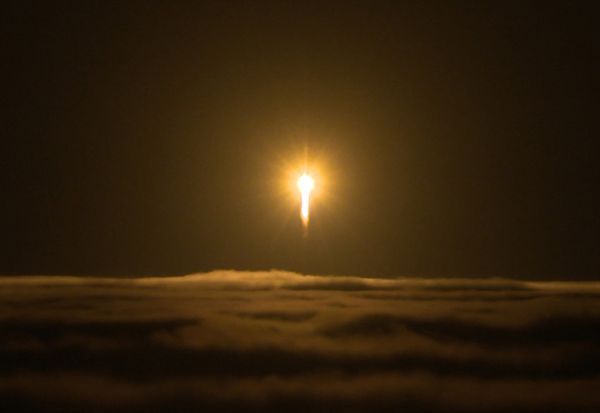
An Atlas V 401 rocket carrying NASA's InSight Mars lander launches from Vandenberg Air Force Base in California...on May 5, 2018.
NASA / Cory Huston

Monday, January 28, 2019

A New Selfie by the Curiosity Mars Rover...

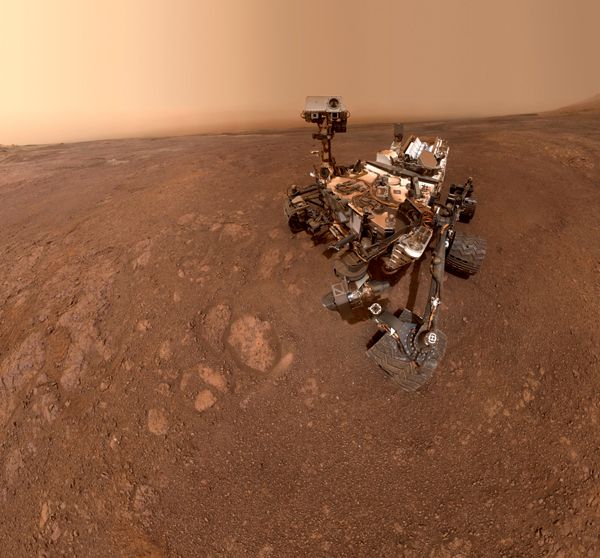
A self-portrait of NASA's Curiosity Mars rover, taken with a camera on her robotic arm on January 15, 2019.
NASA / JPL - Caltech

Curiosity Says Farewell to Mars' Vera Rubin Ridge (News Release)

NASA's Curiosity rover has taken its last selfie on Vera Rubin Ridge and descended toward a clay region of Mount Sharp. The twisting ridge on Mars has been the rover's home for more than a year, providing scientists with new samples - and new questions - to puzzle over.

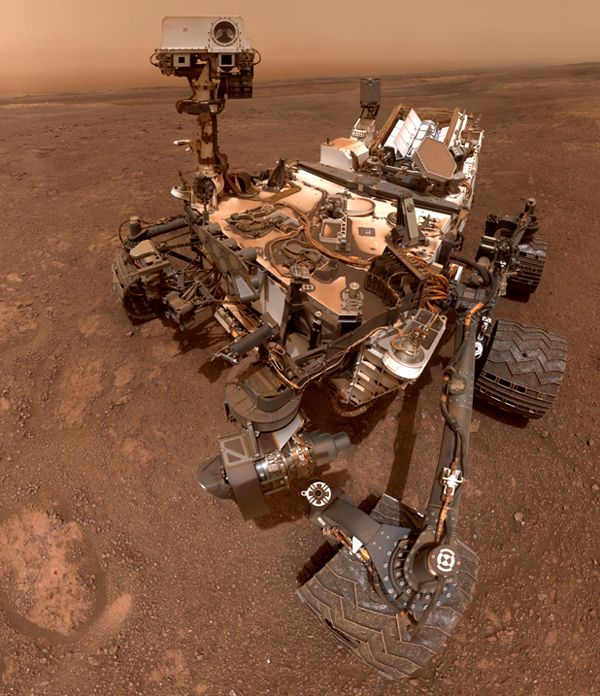
On Dec. 15, Curiosity drilled its 19th sample at a location on the ridge called Rock Hall. On Jan. 15, the spacecraft used its Mars Hand Lens Imager (MAHLI) camera on the end of its robotic arm to take a series of 57 pictures, which were stitched together into this selfie. The "Rock Hall" drill hole is visible to the lower left of the rover; the scene is dustier than usual at this time of year due to a regional dust storm.

Curiosity has been exploring the ridge since September of 2017. It's now headed into the "clay-bearing unit," which sits in a trough just south of the ridge. Clay minerals in this unit may hold more clues about the ancient lakes that helped form the lower levels on Mount Sharp.

Source: Jet Propulsion Laboratory

****

A cropped version of the Curiosity Mars rover's self-portrait, taken with a camera on her robotic arm on January 15, 2019.
NASA / JPL - Caltech

Thursday, January 24, 2019

The New Horizons Spacecraft Releases Its Best Photo Yet from the Ultima Thule Flyby...

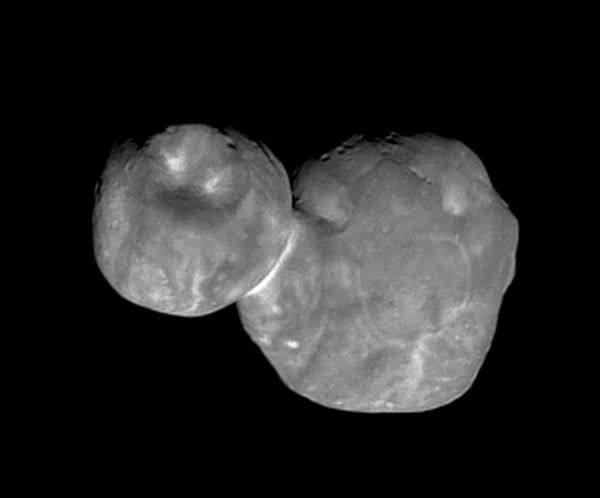
A high-resolution image of the Kuiper Belt object Ultima Thule that was taken by NASA's New Horizons spacecraft from 4,200 miles (6,700 kilometers) away...on January 1, 2019.
NASA / Johns Hopkins University Applied Physics Laboratory / Southwest Research Institute

New Horizons' Newest and Best-Yet View of Ultima Thule (News Release)

The wonders – and mysteries – of Kuiper Belt object 2014 MU69 continue to multiply as NASA's New Horizons spacecraft beams home new images of its New Year's Day 2019 flyby target.

This image, taken during the historic Jan. 1 flyby of what's informally known as Ultima Thule, is the clearest view yet of this remarkable, ancient object in the far reaches of the solar system – and the first small "KBO" ever explored by a spacecraft.

Obtained with the wide-angle Multicolor Visible Imaging Camera (MVIC) component of New Horizons' Ralph instrument, this image was taken when the KBO was 4,200 miles (6,700 kilometers) from the spacecraft, at 05:26 UT (12:26 a.m. EST) on Jan. 1 – just seven minutes before closest approach. With an original resolution of 440 feet (135 meters) per pixel, the image was stored in the spacecraft's data memory and transmitted to Earth on Jan. 18-19. Scientists then sharpened the image to enhance fine detail. (This process – known as deconvolution – also amplifies the graininess of the image when viewed at high contrast.)

The oblique lighting of this image reveals new topographic details along the day/night boundary, or terminator, near the top. These details include numerous small pits up to about 0.4 miles (0.7 kilometers) in diameter. The large circular feature, about 4 miles (7 kilometers) across, on the smaller of the two lobes, also appears to be a deep depression. Not clear is whether these pits are impact craters or features resulting from other processes, such as "collapse pits" or the ancient venting of volatile materials.

Both lobes also show many intriguing light and dark patterns of unknown origin, which may reveal clues about how this body was assembled during the formation of the solar system 4.5 billion years ago. One of the most striking of these is the bright "collar" separating the two lobes.

"This new image is starting to reveal differences in the geologic character of the two lobes of Ultima Thule, and is presenting us with new mysteries as well," said Principal Investigator Alan Stern, of the Southwest Research Institute in Boulder, Colorado. "Over the next month there will be better color and better resolution images that we hope will help unravel the many mysteries of Ultima Thule."

New Horizons is approximately 4.13 billion miles (6.64 billion kilometers) from Earth, operating normally and speeding away from the Sun (and Ultima Thule) at more than 31,500 miles (50,700 kilometers) per hour. At that distance, a radio signal reaches Earth six hours and nine minutes after leaving the spacecraft.

Source: New Horizons Website

Tuesday, January 22, 2019

Photos of the Day: The Super Blood Wolf Moon in Progress...

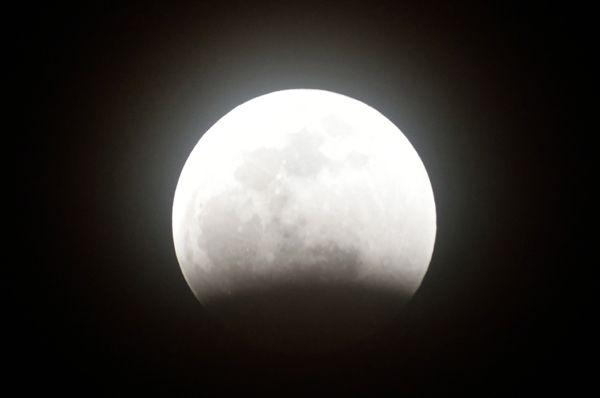
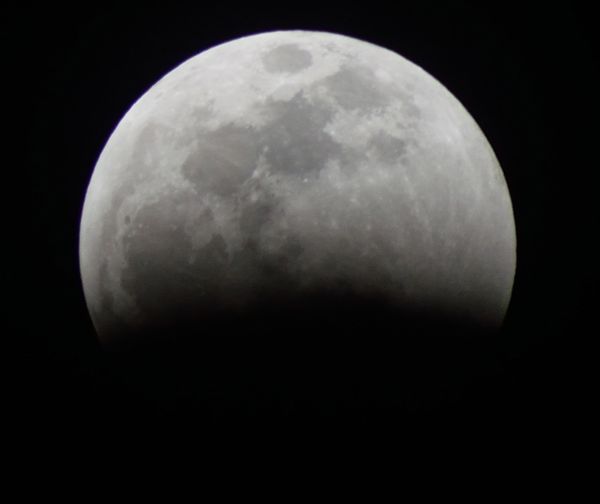
Earth's shadow slowly creeps along the lunar surface...leading up to the Super Blood Wolf Moon lunar eclipse on January 20, 2019.

Just thought I'd share these two pics that I took last Sunday of the Moon as Earth's shadow slowly crept along its surface...leading up to a total lunar eclipse about an hour later. I obviously planned to take snapshots of the Super Blood Wolf Moon once it reached totality, but stupid clouds rolled in by that time and prevented me from doing so. Oh well. To see totality images that I took of the Super Blue Blood Moon almost a year ago (on January 31, 2018), click here. All pics, including the ones posted in this Blog entry, were taken with my Nikon D3300 DSLR camera. That is all!

Earth's shadow slowly creeps along the lunar surface...leading up to the Super Blood Wolf Moon lunar eclipse on January 20, 2019.

Monday, January 21, 2019

Welcome to the 2020 U.S. Presidential Race, Kamala Harris!!!

U.S. Senator Kamala Harris takes part in a group photo before the reading and signing of her new book SUPERHEROES ARE EVERYWHERE inside Barnes & Noble bookstore at The Grove in Los Angeles...on January 13, 2019.

Earlier today, Senator Kamala Harris officially announced that she's running for president in the 2020 American presidential race. All I can say is— That's awesome news! Pretty cool that she made the announcement on Martin Luther King Jr. Day... Harris has the chance to become the first African-American woman (who's also part-Indian) to work in the Oval Office (something that the late Shirley Chisholm attempted to do 47 years ago). To celebrate the occasion, here are two photos taken at a book signing by the senator/presidential candidate that I attended over a week ago.

Kamala Harris, For The People!

About to get an autograph by U.S. Senator Kamala Harris inside Barnes & Noble bookstore at The Grove in Los Angeles...on January 13, 2019.

Sunday, January 20, 2019

The Rams Are Going to the Super Bowl!!!

The Los Angeles Rams are headed to Super Bowl 53...which will be held in Atlanta, Georgia, on February 3, 2019.

Referees, schmeferees— It's not like L.A. running back Todd Gurley had the football deflated or something... Anyways, congrats to the Los Angeles Rams for defeating the New Orleans Saints, 26-23, in the National Football Conference championship game today! Now bring on the Kansas City Chiefs or the New England Cheatriots (in case you're wondering why I made that 'deflated football' comment) on February 3rd...

Here's hoping that unlike a certain Los Angeles baseball team who could've brought home the trophy two years in a row, the Rams will actually win the championship in Super Bowl LIII instead of merely being happy playing for it. Carry on!

EDIT (7:29 PM, PST): F**k the Cheatriots!

The Los Angeles Rams will take on the New England Cheatriots in Super Bowl 53 at Atlanta, Georgia...on February 3, 2019.

Saturday, January 19, 2019

Photos of the Day: The Smoke Plume from a California Rocket Launch...

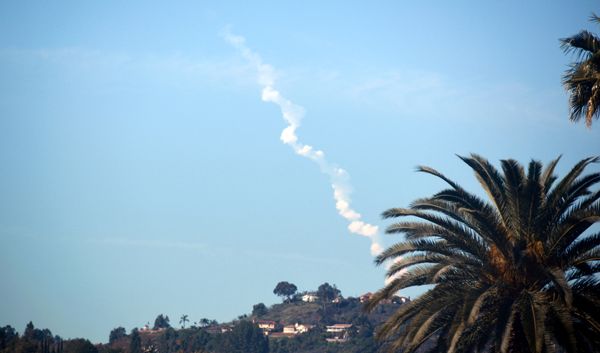
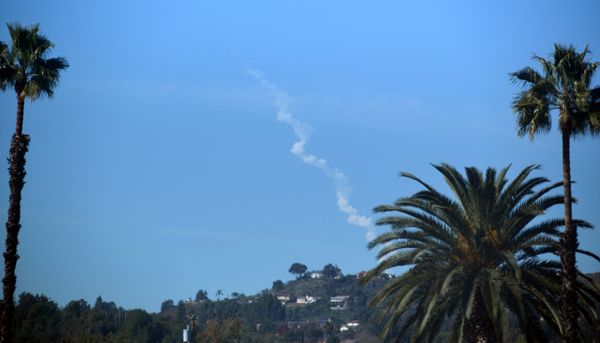
The smoke plume from the Delta IV Heavy rocket's launch from California's Vandenberg Air Force Base is visible from my house in Pomona (189 miles away)...on January 19, 2019.

Just thought I'd share these pics that I took of the exhaust plume from a Delta IV Heavy rocket that lifted off from Vandenberg Air Force Base in Ventura County, California earlier today. I shot these photos while I was at home in Pomona...which is located 189 miles southeast of Vandenberg AFB! The Delta IV Heavy rocket launched at 11:10 AM, Pacific Standard Time—while these images were obtained 9 minutes into the flight, with the payload and its second stage booster well in space, and the smoke trail from the 3 first stage boosters still visible for folks throughout Southern California to see. Nice. The Delta IV Heavy's flight was designated NROL-71, meaning that it was carrying a spy satellite for the National Reconnaissance Office. [The military is fully funded during the partial government shutdown...which is why the U.S. Air Force is still able to conduct rocket launches—as long as they aren't for NASA (which is affected by the government closure).] Carry on!

The smoke plume from the Delta IV Heavy rocket's launch from California's Vandenberg Air Force Base is visible from my house in Pomona (189 miles away)...on January 19, 2019.

The smoke plume from the Delta IV Heavy rocket's launch from California's Vandenberg Air Force Base is visible from my house in Pomona (189 miles away)...on January 19, 2019.

The smoke plume from the Delta IV Heavy rocket's launch from California's Vandenberg Air Force Base is visible from my house in Pomona (189 miles away)...on January 19, 2019.

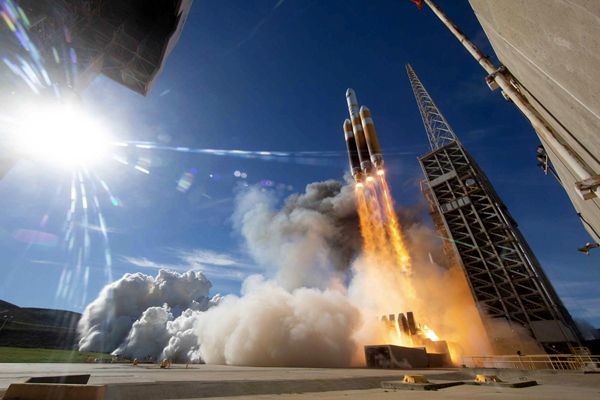
The Delta IV Heavy rocket carrying the NROL-71 payload for the National Reconnaissance Office launches from Vandenberg Air Force Base in California...on January 19, 2019.
United Launch Alliance

Tuesday, January 15, 2019

New Horizons Resumes Transmitting Data from the Ultima Thule Flyby Back to Earth...

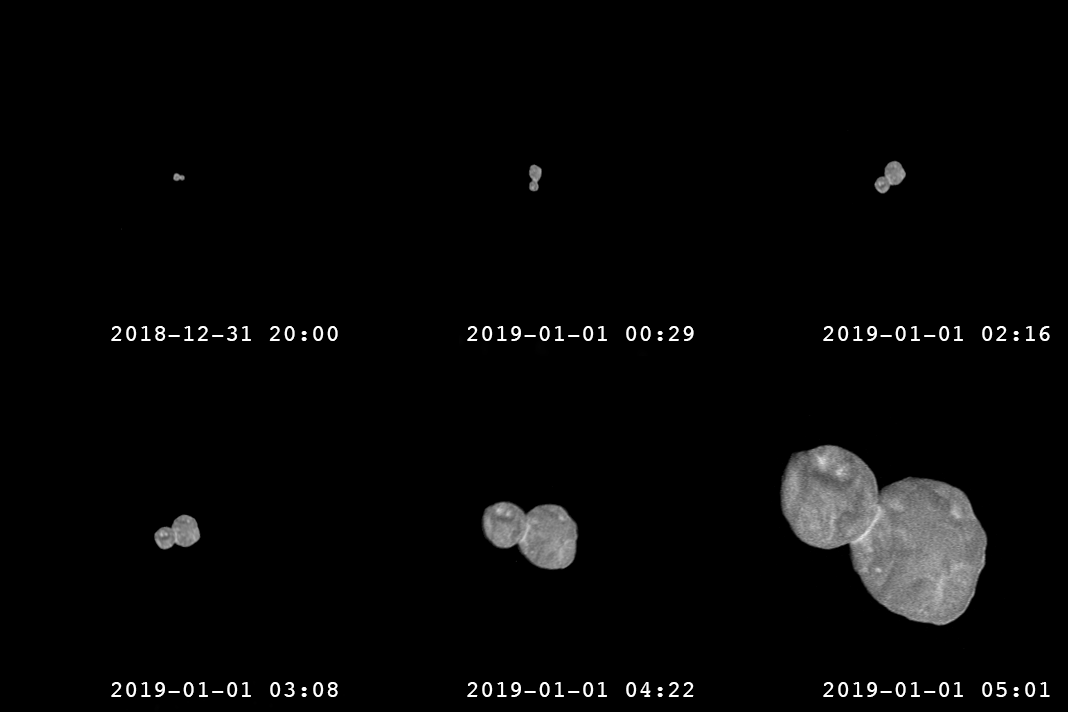
An animated GIF depicting Ultima Thule's propeller-like rotation...as seen over a 7-hour span by NASA's New Horizons spacecraft between December 31, 2018 and January 1, 2019.
NASA / Johns Hopkins Applied Physics Laboratory / Southwest Research Institute / National Optical Astronomy Observatory

New Movie Shows Ultima Thule from an Approaching New Horizons (News Release)

NASA Spacecraft Begins Returning New Images, Other Data from Historic New Year's Flyby

This movie shows the propeller-like rotation of Ultima Thule in the seven hours between 20:00 UT (3 p.m. ET) on Dec. 31, 2018, and 05:01 UT (12:01 a.m.) on Jan. 1, 2019, as seen by the Long Range Reconnaissance Imager (LORRI) aboard NASA's New Horizons as the spacecraft sped toward its close encounter with the Kuiper Belt object at 05:33 UT (12:33 a.m. ET) on Jan. 1.

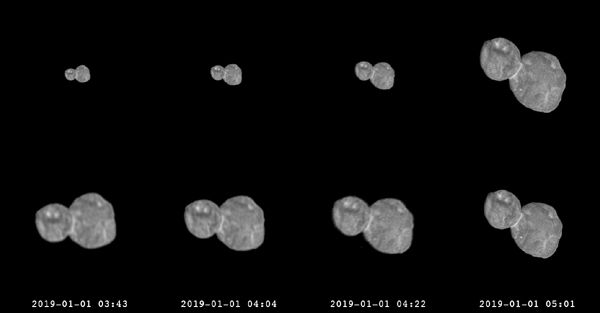
During this deep-space photo shoot – part of the farthest planetary flyby in history – New Horizons' range to Ultima Thule decreased from 310,000 miles (500,000 kilometers, farther than the distance from the Earth to the Moon) to just 17,100 miles (28,000 kilometers), during which the images became steadily larger and more detailed. The team processed two different image sequences; the bottom sequence shows the images at their original relative sizes, while the top corrects for the changing distance, so that Ultima Thule (officially named 2014 MU69) appears at constant size but becomes more detailed as the approach progresses.

All the images have been sharpened using scientific techniques that enhance detail. The original image scale is 1.5 miles (2.5 kilometers) per pixel in the first frame, and 0.08 miles (0.14 kilometers) per pixel in the last frame. The rotation period of Ultima Thule is about 16 hours, so the movie covers a little under half a rotation. Among other things, the New Horizons science team will use these images to help determine the three-dimensional shape of Ultima Thule, in order to better understand its nature and origin.

The raw images included in the movie are available on the New Horizons LORRI website. New Horizons downlinked the two highest-resolution images in this movie immediately after the Jan. 1 flyby, but the more distant images were sent home on Jan. 12-14, after a week when New Horizons was too close to the Sun (from Earth's point of view) for reliable communications. New Horizons will continue to transmit images – including its closest views of Ultima Thule – and data for the next many months.

Source: New Horizons Website

****

These images were used to create an animation demonstrating Ultima Thule's rotation on January 1, 2019...as seen by the Long Range Reconnaissance Imager on the New Horizons spacecraft.
NASA / Johns Hopkins University Applied Physics Laboratory / Southwest Research Institute

Monday, January 14, 2019

Photo and Video of the Day: A U.S. Senator Makes an Appearance at The Grove in Los Angeles...

U.S. Senator Kamala Harris takes part in a group photo before the reading and signing of her new book SUPERHEROES ARE EVERYWHERE inside Barnes & Noble bookstore at The Grove in Los Angeles...on January 13, 2019.

Yesterday, I went to Barnes & Noble at The Grove in Los Angeles to attend a book reading and signing by U.S. Senator Kamala Harris...who promoted her new publication Superheroes Are Everywhere. This book, which is geared towards children, was the only item that Senator Harris signed on Sunday—even though her biography, The Truths We Hold: An American Journey, is also available for purchase. Although yesterday's event was primarily meant for the senator to talk to the young children in audience about who and what inspired her to be where she is today, I felt obligated to drive to The Grove as Harris will presumably be in the headlines a lot next year...as one of many, many Democratic candidates lookin' to unseat that traitor Trump from the White House in the 2020 presidential election.

Missing out on seeing Senator Harris in person would've been akin to me missing out on getting a photo with actress Felicity Jones when she did a Q&A panel after a screening of the Oscar-nominated film The Theory of Everything over four years ago. Had I known that Jones was going to be the lead in Rogue One: A Star Wars Story two years later (I'm a huge Star Wars fan, of course), I would've definitely walked over to where she and co-star Eddie Redmayne were standing inside the auditorium to try to get a pic with her. But this Blog entry isn't about the actress who would play the heroic Jyn Erso (as well as real-life hero Ruth Bader Ginsburg in the recently-released On the Basis of Sex) on the big screen; it's about an American senator who will position herself as the hero who removes a Russian patsy from the Oval Office come November of 2020 (assuming Robert Mueller's report doesn't force Senate Republicans to finally grow a pair and impeach Dotard 45 by then). That is all.

Friday, January 11, 2019

About China Landing a Spacecraft on the Far Side of the Moon...

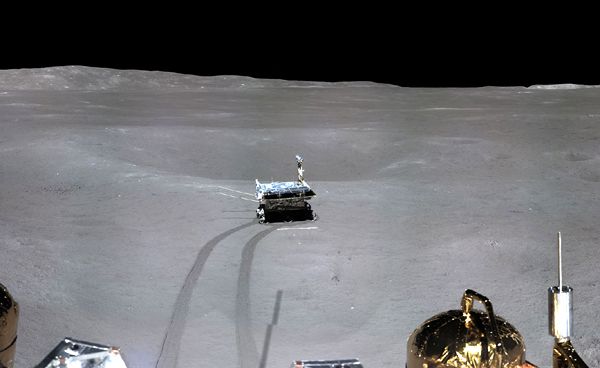
A snapshot of the Yutu-2 rover that was taken by the Chang'e 4 lander on the far side of the Moon.
CNSA

HEY CHINA, I would like to say thanks for allowing the general public to submit their names online so that they could join the Chang'e 4 lander and Yutu-2 rover on the far side of the Moon...just like how Japan's space agency and NASA allowed people to fly their names on the Kaguya spacecraft and Lunar Reconnaissance Orbiter about a decade ago, respectively. Oh wait— You didn't invite the public to fly their names on the Chang'e 4 mission to the Moon...

THANKS FOR NOTHING, JERKS.