Tuesday, July 31, 2018

A New Look for the L.A. Lakers!

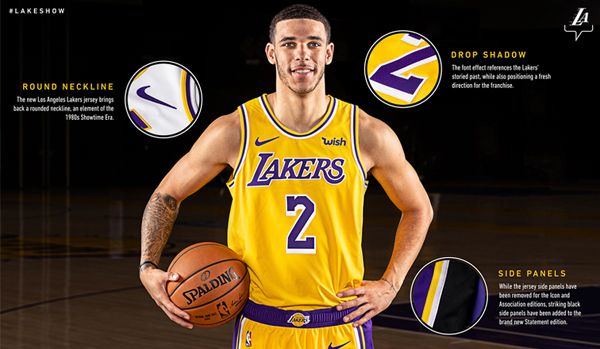
Lonzo Ball shows off the new L.A. Lakers jersey that he, LeBron James and Co. will wear for the 2018-'19 NBA season.
Ty Nowell and J Alexander Diaz / Los Angeles Lakers

So thirty days after LeBron James announced to the world that he was going to play in Los Angeles starting next season, and hopefully bring 'Showtime' back to the Lake Show during his tenure, the new Showtime-inspired jerseys that Lakers players will wear starting this Fall were unveiled online. Pretty cool. The fact that LeBron personally tweeted about it below shows that he most likely had a hand in the Lakers changing the design of their uniforms to mark the beginning of a new era.


Keep in mind that the Lakers switched from the Showtime-era jerseys to a new uniform when the team started playing at STAPLES Center in the 1999-2000 season...which also marked the year that Shaquille O'Neal and Kobe Bryant won their first NBA title. Hopefully, LeBron James, Rajon Rondo, Lance Stephenson and company will repeat history—with new star players and new jerseys (but obviously no new arena) for L.A. equaling at least a nice playoff run next Spring! Let's cross our fingers, Lakers fans.

Shaquille O'Neal and Kobe Bryant don Lakers jerseys that were redesigned for the 1999-2000 NBA season...the year that Shaq and Kobe won their first championship.

Friday, July 27, 2018

TESS Has Begun Its Search for New Exoplanets!

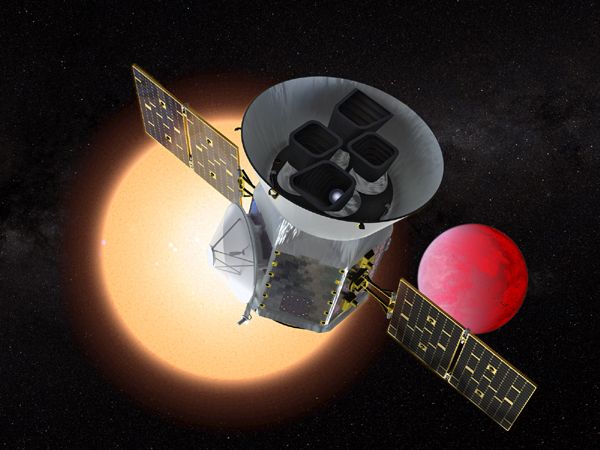
An artist's concept of NASA's TESS satellite searching for exoplanets in deep space.
NASA GSFC

NASA’s TESS Spacecraft Starts Science Operations (News Release)

NASA’s Transiting Exoplanet Survey Satellite has started its search for planets around nearby stars, officially beginning science operations on July 25, 2018. TESS is expected to transmit its first series of science data back to Earth in August, and thereafter periodically every 13.5 days, once per orbit, as the spacecraft makes it closest approach to Earth. The TESS Science Team will begin searching the data for new planets immediately after the first series arrives.

“I’m thrilled that our new planet hunter mission is ready to start scouring our solar system’s neighborhood for new worlds,” said Paul Hertz, NASA Astrophysics division director at Headquarters, Washington. “Now that we know there are more planets than stars in our universe, I look forward to the strange, fantastic worlds we’re bound to discover.”

TESS is NASA’s latest satellite to search for planets outside our solar system, known as exoplanets. The mission will spend the next two years monitoring the nearest and brightest stars for periodic dips in their light. These events, called transits, suggest that a planet may be passing in front of its star. TESS is expected to find thousands of planets using this method, some of which could potentially support life.

TESS is a NASA Astrophysics Explorer mission led and operated by MIT in Cambridge, Massachusetts, and managed by NASA’s Goddard Space Flight Center in Greenbelt, Maryland. Dr. George Ricker of MIT’s Kavli Institute for Astrophysics and Space Research serves as principal investigator for the mission. Additional partners include Northrop Grumman, based in Falls Church, Virginia; NASA’s Ames Research Center in California’s Silicon Valley; the Harvard-Smithsonian Center for Astrophysics in Cambridge, Massachusetts; MIT’s Lincoln Laboratory in Lexington, Massachusetts; and the Space Telescope Science Institute in Baltimore. More than a dozen universities, research institutes and observatories worldwide are participants in the mission.

Source: NASA.Gov

****

Thursday, July 26, 2018

BepiColombo Update: Europe and Japan's Upcoming Mission to Mercury Gets a Launch Date!

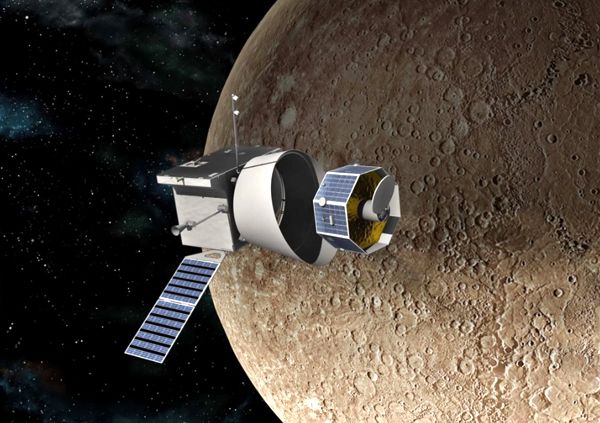
An artist's concept of Europe's Mercury Planetary Orbiter and Japan's MIO spacecraft (the smaller probe at right) that comprise the BepiColombo mission to Mercury.
Astrium

The International Mercury Exploration BepiColombo Launch Schedule (Press Release)

Below is the launch schedule for BepiColombo, a leading Japan-Europe mission to Mercury. BepiColombo consists of two spacecraft - JAXA's MIO, the Mercury Magnetospheric Orbiter and the Mercury Planetary Orbiter (MPO) of the European Space Agency (ESA). Both orbiters carried aboard Ariane 5 will cooperatively accomplish comprehensive observations of Mercury. Be informed of the following Ariane 5 launch schedule officially announced by Arianespace SA and ESA.

Launch Time and Date: 22:45, local time in French Guinea, October 19, 2018
(10:45, Japan Standard Time, October 19, 2018)
Reserved Launch Period: Through November 29, 2018
Location: Guiana Space Centre, Europe's spaceport in Kourou

Mission Overview: The International Mercury Exploration BepiColombo Mission and MIO

BepiColombo, an ESA-JAXA joint mission to explore Mercury, sends two spacecraft to orbit around Mercury for observations. Each is tasked with distinctive observation objects. MIO aims at elucidating the magnetic field and magnetosphere of Mercury. The MPO mission is observing the planet's surface and internal composition. JAXA is in charge of the development of the MIO spacecraft and controlling its operation at the target orbit because MIO's mission objectives lie in Japan's area of expertise. ESA controls BepiColombo launch and flight to Mercury and orbital insertions. The development and operation of the MPO is also part of the mission performed by ESA.

MIO and MPO are payload launched by the Ariane 5 spacecraft. After entering the planet's orbit, detached satellites are scheduled for approximately year-long observation mission, which both agencies will cooperatively engage in.

Source: Japan Aerospace Exploration Agency

Tuesday, July 24, 2018

The Launch of the Parker Solar Probe Has Been Pushed Back 5 Days...

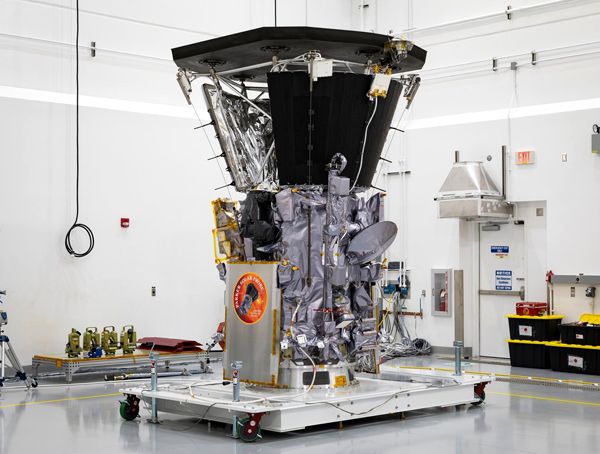
NASA's Parker Solar Probe on display inside the Astrotech Space Operations facility in Titusville, Florida.
NASA

Earlier today, NASA announced that the impending launch of its Parker Solar Probe has been delayed from August 6 to August 11 (after having an original flight date of August 3)...due to a piece of foam that technicians at Astrotech Space Operations (in Titusville, Florida) found inside the Delta IV Heavy payload fairing after Parker was recently encapsulated inside it. This is good news to me—as I probably would've missed the launch if it took place on August 6 (Monday) due to work. The Delta IV Heavy rocket that will send Parker towards the Sun is now set to depart from Cape Canaveral Air Force Station in Florida on August 11 at 3:48 AM, Eastern Daylight Time (12:48 AM, Pacific Daylight Time). I can live with that!

Sunday, July 22, 2018

Photos of the Day: Pluto and Charon in All Their True-Color Beauty...

NASA's Parker Solar Probe on display inside the Astrotech Space Operations facility in Titusville, Florida.
NASA / Johns Hopkins University Applied Physics Laboratory / Southwest Research Institute / Alex Parker

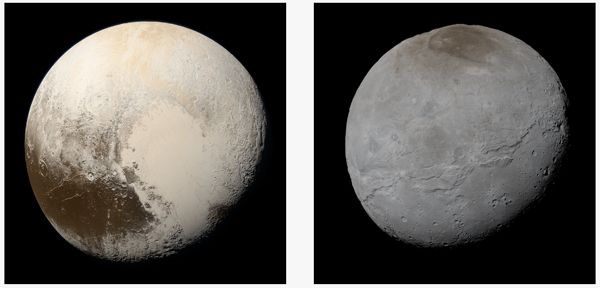
To commemorate the 3-year anniversary of the Pluto-Charon encounter by NASA's New Horizons space probe on July 14, the craft's mission team released these images showing the two celestial bodies and how they would look to the human eye. The Charon photo was taken from a distance of 46,091 miles (74,176 kilometers), while the snapshot of Pluto was achieved by New Horizons from a much closer range of 22,025 miles (35,445 kilometers). Both pics were obtained with New Horizons' Multispectral Visible Imaging Camera during the encounter. Less than 5 months from now, the world is set to take a close-up glimpse of another object in the Kuiper Belt: Ultima Thule (formerly known as 2014 MU69)...courtesy of New Horizons once more. This historic flyby is set to occur on January 1, 2019. Understatement of the Day: This is an awesome way to start the New Year! Have a great week ahead.

Saturday, July 21, 2018

Quote of the Day, Part 2...

I recently found this pic on Facebook. I can relate to this quote...but mostly in a negative way. Carry on!


I can relate to this quote...but mostly in a negative way.

Friday, July 20, 2018

Quote of the Day...

"Don't grow complacent in life. God will punish you for it."

-― Me

Wednesday, July 18, 2018

A Quick Lakers Update...Sort of

So online reports this morning have stated that 2014 NBA Finals MVP Kawhi Leonard has been traded to the Toronto Raptors from the San Antonio Spurs...in exchange for Toronto's 4-time NBA All-Star DeMar DeRozan going to Texas. Assuming that Kawhi Leonard keeps true to his word and joins the Los Angeles Lakers as a free agent in summer 2019 (or before the trade deadline next February?), the Spurs clearly emerged as the winners of this deal. And Toronto? Have fun watching your newly-acquired one-year (or less?) rental potentially phoning it in during the 2018-'19 NBA season! Again, this is assuming that Leonard doesn't change his mind and decide to stay with the Raptors after next year. (Considering the fact that Kawhi wanted to move back to his home city of Los Angeles, and San Antonio decided to send him to a team that's over 2,500 miles from L.A. and located out of country instead, I don't see this as likely. Hopefully.) I'm lookin' at you, Paul George... For those of you non-NBA folks reading this, Google the reference.

Happy Hump Day!

Could Kawhi Leonard join forces with LeBron James on the L.A. Lakers as soon as February, 2019? We'll see. Guess who I cropped out of this pic...

Tuesday, July 17, 2018

A New Look for AIR FORCE ONE?

Donald Trump's version of Air Force One? This satirical artwork isn't so far-fetched.
Alex Gonzalez

So according to this article in The Washington Post, Donald Trump wants to give the next version of Air Force One a makeover. He wants to give the next presidential jet a red, white and blue color theme. Just as an FYI, the Russian flag—like America's Old Glory—is also red, white and blue.

The Russian flag.

Thursday, July 12, 2018

TESS Update: The Spacecraft's Search for New Alien Worlds Should Begin by Month's End...

An artist's concept of NASA's TESS satellite searching for exoplanets in deep space.
NASA GSFC

NASA’s TESS Spacecraft Continues Testing Prior to First Observations (News Release - July 11)

After a successful launch on April 18, 2018, NASA’s newest planet hunter, the Transiting Exoplanet Survey Satellite, is currently undergoing a series of commissioning tests before it begins searching for planets. The TESS team has reported that the spacecraft and cameras are in good health, and the spacecraft has successfully reached its final science orbit. The team continues to conduct tests in order to optimize spacecraft performance with a goal of beginning science at the end of July.

Every new mission goes through a commissioning period of testing and adjustments before beginning science operations. This serves to test how the spacecraft and its instruments are performing and determines whether any changes need to be made before the mission starts observations.

TESS is a NASA Astrophysics Explorer mission led and operated by MIT in Cambridge, Massachusetts, and managed by NASA’s Goddard Space Flight Center in Greenbelt, Maryland. Dr. George Ricker of MIT’s Kavli Institute for Astrophysics and Space Research serves as principal investigator for the mission. Additional partners include Northrop Grumman, based in Falls Church, Virginia; NASA’s Ames Research Center in California’s Silicon Valley; the Harvard-Smithsonian Center for Astrophysics in Cambridge, Massachusetts; MIT’s Lincoln Laboratory in Lexington, Massachusetts; and the Space Telescope Science Institute in Baltimore. More than a dozen universities, research institutes and observatories worldwide are participants in the mission.

Source: NASA.Gov

****